Simple Beauty in Kabul

After a month of frequent hello’s and short conversations, my Afghan friend AJ offerred to accompany me to any place I wanted to see in Kabul before it was time for me to leave the country.  The offer alone was flattering, knowing how often foreigners pass through this country doing short-term jobs and then moving on, I was honored AJ would spend time with me to see things he had probably seen a million times.   I told him I had read about the Bagh-e-Babur Gardens and that I would really like to see them.  Without giving me the least bit of a “that’s boring” reaction, AJ started planning the when and how.

A few days later we were in a taxi and speeding off to the Babur Gardens, built in 1528AD by the Moghul emporer Babur.  The whole cab ride AJ flipped through some wrinkled pages with Dari writing on them, I soon realized he had printed out background information for our journey. As any journey across Kabul requires, we were met with plentiful traffic which gave us more time to discuss education in Afghanistan and the United States, as well as asking the cab driver about his age and his upcoming marriage.  Crossing over the almost dry Kabul River, the gardens came into view, perched on the mountainside behind large walls that very successfully hide the splendor within.
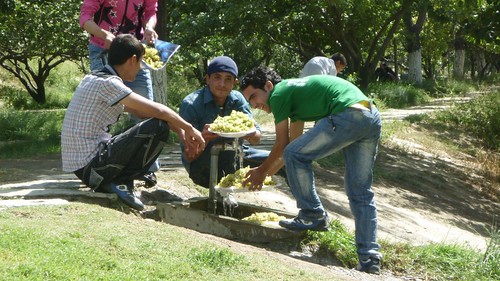
Friends Washing Grapes

After a brief discussion about how terrible it is that foreigners must pay money for accessing public gardens, we made our way passed the guards, passed the walls, and into the green.  Suddenly the world turns peaceful, the air turns clean, and the stone faces on the street give way to smiles.  As we walk up the tree lined path, I notice beautiful roses and an array of flowers to our right. Beneath the trees to our left there are people, men, women, friends, couples, sprawled out and relaxing just a few hours before lunch.  Some are speaking quietly to each other, others in large groups seem to be telling stories and having a good laugh, still others aren’t talking at all, just enjoying the tranquility.

A ten to fifteen minute walk up the path and we’ve reached a group of buildings. “This one is a ceremonial hall, that back there is a mosque, and up there is the tomb of Babur,” AJ explained to me enthusiastically, as we walked from one to the other. Upon arrival at the tomb we’re greeted by an old man with an ID badge on his arm, he welcomes us after waving goodbye to the previous visitors. What follows is a 4 minute, well memorized account of who is buried here, when they were buried, and what is written on the tombstone.  I would love to share with you what he said, but it all happened so quickly, all I know is that it sounded fantastic.  “Please sign the book”, he motions towards a series of books where tourists leave little messages.  I decide out of all the languages and identities that might already be in the book, it could use a Portuguese text, so I go to work on a nice message from Mark from Lisbon.

For several more hours AJ guided me past a palace, by the greenhouse, and towards a few works of art hidden between the trees and walkways.  Throughout this time we discuss the complexities of life in Afghanistan, from work to school, love to family, religion to tribes, it is one big final lesson in things I have been learning about all month.  These discussions are interrupted frequently as I stop to snap a picture or record a video, each time AJ would wait patiently for me, before carrying on where we left off.
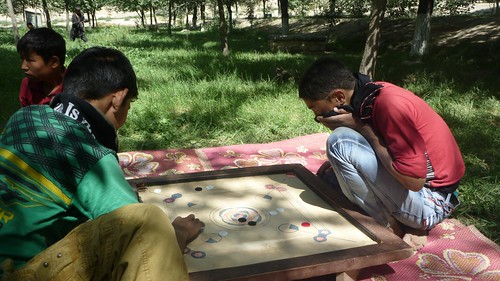
Kids Playing The Game

Towards the end of our visit we spotted an open childrens’ game involving sliding plastic circles over a wooden board, a quick explanation and we found ourselves wrapped up in several games for some time.  The snack stand guy near us walked over from his responsibilities to watch us play.  He tried his best in Dari to coach me to victory, but in the end the foreigner could not master this unfamiliar game and AJ took the match.  As we said goodbye to the man, I shook his hand and snapped one more picture of the board.  Again AJ waited for me to take all the pictures I felt I needed to take, then he turned to me and said, “Thank you for coming here and taking these pictures. Thank you for sharing such moments with your friends so that they know that in Afghanistan it is not just war and bad things.” His words echoed in my head as we enjoyed one last fresh apple juice and walked back through the front gate and into a taxi.  I scanned the sad looking Kabul River for traces of water, and thought about all the beautiful things and people I have encountered, and how they have forever changed what I think of this magical country.
The Language of War

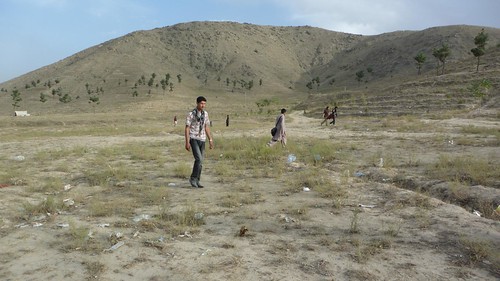
The De-Landmined Kabul Golf Club

Afghanistan is a country of many ethnicities, tribes and languages, which many people can explain to you if you have the time to listen.  But there is one language you don’t often read about that is spoken throughout Kabul and no doubt the nation. In café’s and restaurants, over lunch and late into the night after dinner, Afghans and foreigners alike, are speaking the language of war.

The language of war consists of words connected to violence and armed conflict, both in the present and the past tense.  It is made up of the saddest and most terrifying stories; about murder, kidnapping, threats, moments of extreme panic, and people who have been lost to any of these.  It is spoken by those who have been here for 5 years or 5 days, spoken while passing the rice or just passing time at a friend’s house. Beyond any of this, it is spoken with an ease and regularity that makes it one of the most widely spoken and understood languages in the nation.

I find history to be one of the most important and interesting topics one can discuss, no matter how exciting or mundane. I find personal experiences to be a constant source for learning and inspiration. Yet after almost one month listening the accounts of what it was like in what terrible situation, from both participants and observers, I find myself hating history and personal experience.  Unable to listen to the language of war because something about it seems so bad for everyone in the conversation.

Surely there are import lessons to be learned from discussing these topics.  Surely if our nations, our fellow humans, can carry out all the terrible actions of war, then we can confront them and not be afraid to examine these events among friends. Why should the language of war be considered taboo, when hiding the truth can only serve to keep us from learning lessons and not repeating mistakes.

While I know how important testimony and understanding are, especially in the context of war or violence, I am taken aback by the language of war.  I want to stop the stories. I want to turn up the music. As strange as it may seem, the more the language of war is spoken, the less meaning it has to me, the previously outspoken citizen journalist.

bmtv116 Kabul Golf Club

We rambled into the Kabul Golf Club one afternoon in September, as we had heard there was a golf course in the outskirts of Kabul where one could play nine holes like no others in this world.  What we found was a charming and forgotten course with a staff that are extremely happy to see you.  Among the stars of the day was Mohammad Afzal Abdul, club Pro and our escort the entire afternoon.  He has run the club for the last 40 years, facing imprisonment twice and a laundry list of problems as Afghanistan has struggled over the last few decades.  The following is a video interview I did with him as we made our way through the course.

Regardless of Outcome

Istaliff, Afghanistan

It is Friday night, election eve, here in Kabul. The walk home from dinner was quiet, dark, and strange feeling. One might interpret this atmosphere as the calm before the storm, as tomorrow at 5am polling stations will start to open all over the nation.

At work my Afghan colleagues mention at what time they plan to vote during the course of the workday. On the way home I asked the cab driver if he would vote tomorrow, “Oh yes… oh yes” he said without hesitation. At the front gate I greeted a neighbor and asked him about voting plans tomorrow, “Yes for sure” responds my neighbor, as if the question itself does not need asking. A seemingly calm city and a hand full of enthusiastic citizens surely skews my vision of what is certainly not a rosy picture across the country.

There is no shortage of threats and conflicts surrounding both the elections and the campaign leading up to them. Many pointed to the kidnapping of a candidate earlier today, as a sign of how bad things are. Earlier this month the murders of campaign workers and candidates, more stories that have echoed through the globe, as examples of a process that couldn’t possibly be considered successful.

But what about in cities throughout Afghanistan where a record number of candidates (2,577+) are not only on the ballot but actively campaigning. Candidates of different cultures, tribes, gender, ages, and political backgrounds, all taking part in the process despite the risks and the cynicism. There is also the voting material, destined for 5,897 polling stations, being carefully shipped and stored to be ready for the voting process that begins in a matter of hours. In many remote areas of the country, this essential material is transported by donkey, as the most reliable and time-tested form of transportation. The list of people and resources mobilized for these elections is of a scale that cannot be simply written off as insignificant.

Yet these words will be drowned out almost immediately as the bad things that have happened and will happen get amplified by those trying to measure what is happening here. People demand conclusions as quickly and easy to read as possible, which often means nevermind what has gone right, and what is commendable and positive about this process, it is easier to remember and tell the stories of bombs, kidnappings, fraud and dysfunction.

For my part, even before the voting has begun, I know what I’ve seen here, and I’ve spent lots of time reading and hearing reports from across this nation. Regardless of what the media says and what the pundits conclude or how they choose to insult those that share my observations and opinions, I’m telling you that something good and special is going on here. This phenomenon does not end on election day, there will be no declaration of victory or defeat, this is simply one more step along a very difficult path.

bmtv115 Eid Vlog

As hard as it has been to record a video entry from Afghanistan, I’m finally getting the hang of when is a good moment. The following video entry was recorded from a friend’s balcony on the first day of Eid. Just a little video hello, one week before the much anticipated Afghan Parliamentary Elections.

Kites of Kabul

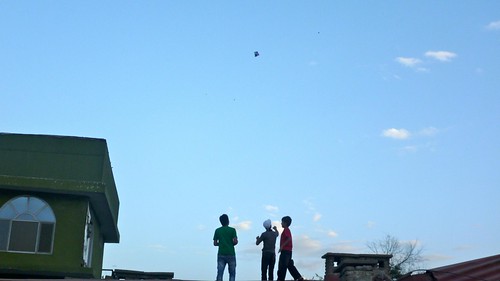
Flying High Above Kabul

I turn left into an alleyway which is narrow and somewhat foul smelling from the open sewer, like many alleys in Kabul. I’m thinking of what tasks still need to be done today and wondering how late I am for my next appointment, when suddenly a group of kids will run right passed me.  They seem to be chasing something, looking up at the sky as they run and calling to someone nearby even though I can’t see another person over the tall walls which frame these alleyways.  I suddenly realize they’re following kites, as I raise my face to the sky to see the scores of little specks in the sky.  I stop walking, taking note if anyone is coming who might notice my foreign-ness, and I stare at the dancing kites in the sky with a big smile on my face.

Hours later I’m back at my residence and I decide to go on the roof to see what I can see.  It is the last day of Eid, the very important holiday in the Muslim faith, and as one would expect on a holiday, from high above the city sounded calm. Yet on every rooftop including my own, groups of children are huddled together unravelling spools, squinting at the sky, and mending wounded kites.  Those that aren’t working on something kite related are doing something with their own rooftop pigeons.

I notice the ladder leading up to another rooftop area, higher up then this one, where more kids are flying kites. As a matter of fact I notice many ladders, the primary means for kids to run from rooftop to rooftop, all in the name of kites.  I give a warm nod to each of the kids, who seem surprised to see me at first, and then completely used to my presence.  Even stopping to pose for a picture since they notice I’m using my little compact camera. I climb up next to them. Now, to the casual observer, I might even be in the kite flying business myself, standing next to one taller boy who seems to be running two kites that are flying higher those almost anyone can see.  He motions with his hands and adjusts the spool with lightening agility, looking more like a master puppeteer than a kid with a kite.  As the afternoon comes to a close and the sun passes almost behind the mountains that surround Kabul, the hundreds of kites that cover the sky like birds in formation start to disappear.  My own rooftop colleagues grab the spools and cut the lines, making me wonder where their kites end up. They make for the ladders without looking at me. Just when I feel completely invisible, on my way down the ladder I can feel someone holding it steady for me. “Thank you” I say to the one of the boys in Dari and English, “You are welcome” he responds in his best english. By the time I’ve reached the bottom of the ladder, he and the kite kids have vanished, for what I can only imagine is dinner time. The end of another day filled with paper, tape, and string, another day of ruling the skies.

As I sit back down at my desk with fresh images of kite flying in my head, I get a message from a friend asking what meaning Sept. 11th has for people in Kabul.  I have no big answer for such a question, all I can think of is what a great day it was to fly a kite.